
The Breakroom

Wallaroo and SwiftUI (1 of 5)

September 19, 2022

By Sean Heber

The Iconfactory has been releasing beautiful wallpapers on Patreon for years. Our latest app, Wallaroo, was built to make the process of browsing and using these hundreds of wallpapers more fun and convenient for everyone.

Wallaroo is the first app we’ve built entirely with SwiftUI, so in this series of more technical posts, I want to talk about some specific issues we ran into along with how we solved them. In a separate post, Craig discusses development of the whole app so if you prefer to get a bird’s eye view of Wallaroo’s creation, be sure to check his article out.

Over two months of development, all of us at the factory worked on the app in our own ways. Craig and I did the programming while the designers remastered a ton of their artwork, mocked up UIs, made marketing materials, filled out spreadsheets with metadata, and did all of the other little things that needed doing that us programmers like to pretend don’t exist.

Craig built the entire server backend (where the metadata and images live) as well as Wallaroo’s settings and StoreKit 2 purchasing flow while I worked exclusively on the primary functionality of the frontend. (Now that I write it out I suddenly feel like a total slacker…)

One thing that worried me about adopting SwiftUI was that the demos from WWDC and elsewhere always seemed so superficial. While they usually have pretty animations and relatively few lines of code, most of the apps felt like nothing more than a thin wrapper around a list view. As someone who has done battle with UIKit for over a decade, I know how often a seemingly simple thing can turn out to be ridiculously complicated in practice. Given this, I really had no sense for how SwiftUI might fare when faced with real-world complications.

Since Wallaroo wasn’t designed to be a particularly complex app, it seemed like the perfect time to find out by taking the SwiftUI plunge.

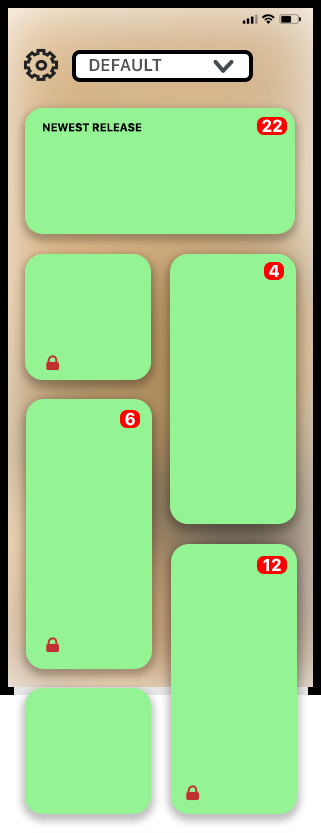
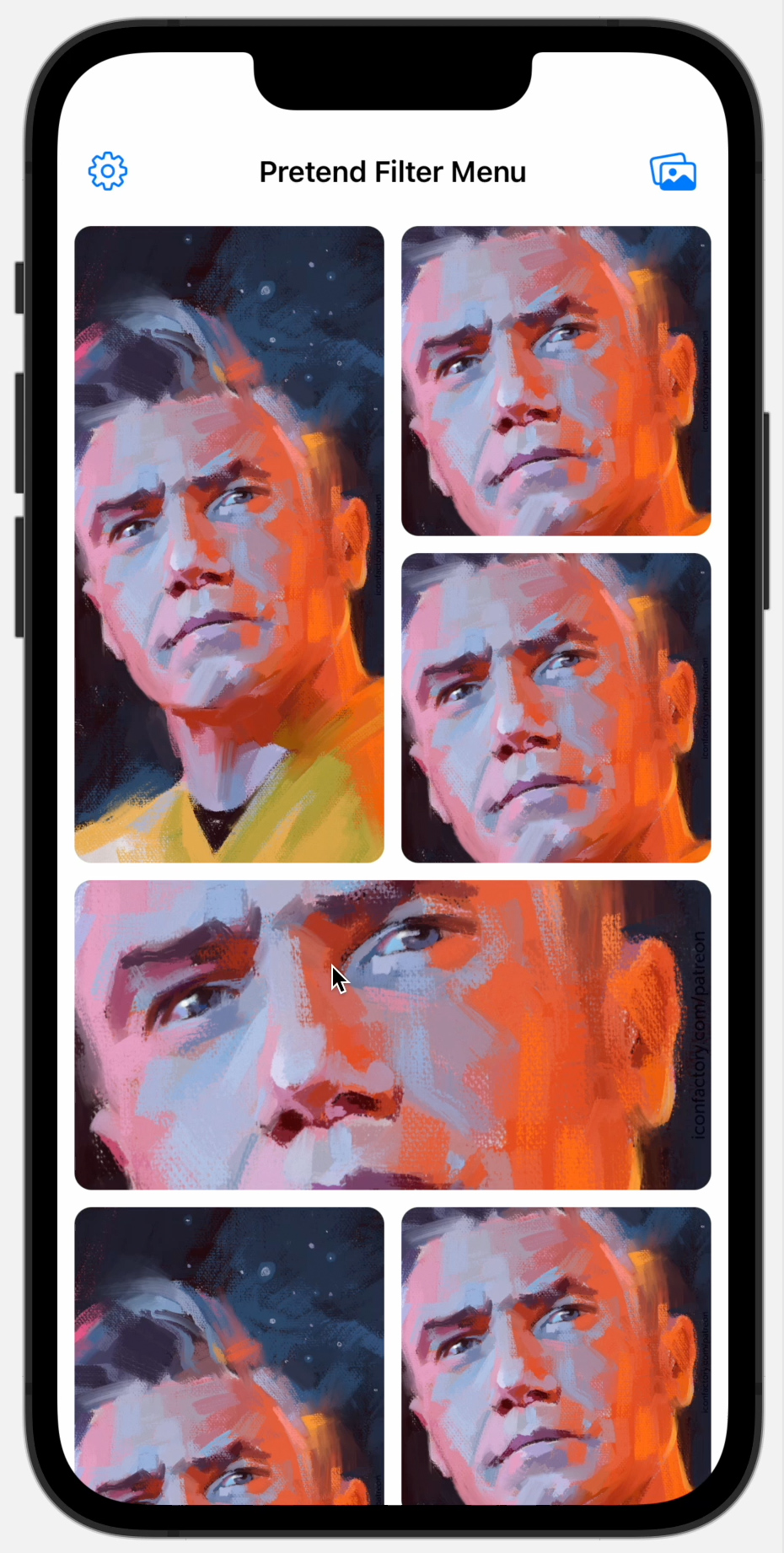
Early Wallaroo gallery concept by Talos Tsui.

The mockup that Talos did of what would become the main Wallaroo gallery view had each wallpaper release being presented in one of four different-sized randomly selected tiles. From what little I knew of SwiftUI, I suspected this was going to be tricky because the framework didn’t (and still doesn’t) have even a simple flow layout, let alone something complicated like a flowing irregular grid! Luckily WWDC22 had just announced the new Layout protocol for SwiftUI, so I hoped I’d be able to use it to make this work. Nothing else about the UI mockups seemed especially unusual or beyond SwiftUI demos I had seen before, but the layout we wanted was something new. So I started there.

Considering that the only SwiftUI work I had done prior to building Wallaroo were some simple toy views over a weekend, it felt a bit like jumping into the deep end to immediately start work on a custom layout – but it turned out to not be too bad! The first decision I made was to avoid trying to implement a “perfect” layout and just get it working for the cases we needed. This meant mostly ignoring infinite and zero size proposals and disregarding the preferences of the children. (I’m sure all the kids out there can relate.)

One of the more interesting things about the grid is how we wanted to randomize the shapes of each child view to keep the gallery fresh and visually call attention (by way of size) to different wallpapers over time as the list of releases changed. I didn’t want to have to somehow assign a “shape” to each child view from outside of the layout, so I tried to find a way to get this logic inside of it so it could be automatic.

What I came up with was to seed a random number generator with the number of subviews that the layout received. This ensured that the layout would be consistent as long as the wallpaper list didn’t change – which is what we wanted. I then used that random number generator to shuffle a bag of shapes (large, vertical, horizontal, and small) and pulled the next one whenever processing the next subview. If the pulled shape would fit in the remaining horizontal space, I used it. If it didn’t fit, I’d discard it and try again. When the bag was empty, I’d fill it back up with a couple of sets of shapes, shuffle it, and keep going. I think it worked remarkably well! (Incidentally I used a similar technique to randomize Frenzic: Overtime’s daily challenges by seeding the random number generator with Game Center’s current leaderboard date.)

We were a few days into this, and I was feeling pretty good about it when the first real-world complication reared its ugly head: Custom SwiftUI layouts aren’t lazy!

The Captain Pike Appreciation App. Anson Mount knows how to hit it.

This became distressingly apparent when I replaced the one bundled test image I was using for each of my tiles (a wonderful portrait that Dave did of Captain Pike from Star Trek: Strange New Worlds) with URLs for images on our server.

Suddenly whenever the app launched or the gallery came back into view, all 15 or so test images would start downloading immediately even if they were well off the screen – which obviously wasn’t going to scale. This happened because AsyncImage (which I was using at the time) starts loading when the view pops into existence in the view hierarchy and not when the view actually becomes “visible” on screen. Doh.

What I needed to solve this was some way to discern if the view was actually on screen or not and then emit the appropriate view. Since I had already put the GalleryView inside of a ScrollView in order to scroll, it turned out to be easy to capture a rectangle that could be used to indicate the “on screen” frame by simply putting the ScrollView itself inside of a GeometryReader.

The next step was to figure out where on screen the child views were actually being placed. This was easily accomplished by putting each of the children of the layout inside their own GeometryReader, too.

So now I had two rectangles in global coordinates – one for the container frame, and one for the frame of the child view. After that it was just a matter of checking if those rectangles intersected or not and either emit or not emit the tile view. SwiftUI’s ViewBuilder has no problem with this – it worked great. Now all of the child views would only exist when actually on the screen and cease to exist when they left it. This allowed for images to be lazy loaded as you scrolled without any child views needing to worry about the details.

I think laziness for custom layouts ought to be built into SwiftUI, but at least my code for adding it turned out to be relatively simple in our case:

GeometryReader { galleryGeometry in
    ScrollView {
        let visibleGalleryFrame = visibleFrame(for: galleryGeometry)
        GalleryLayout(columns: visibleColumns(for: galleryGeometry.size), padding: 20) {
            ForEach(releases) { release in
                GeometryReader { cellGeometry in
                    if visibleGalleryFrame.intersects(visibleFrame(for: cellGeometry)) {
                        ReleaseTileView(release: release)
                    }
                }
            }
        }
    }
}

(Note: The visibleFrame(for:) function just expands the safe area the geometry proxy includes so that the returned CGRect is the actually visible space and not just the safe area space.)

By this point things were looking and working pretty well for an early prototype – the primary stuff we were worried about being able to build in SwiftUI seemed to be solved! I was about to move on to other parts of the app when Gedeon said, “Hey, can we add some parallax when scrolling?”

Actual photo of Sean’s reaction when Gedeon suggested adding parallax.

What’s New? Wallaroo!

September 12, 2022

By Webmaster

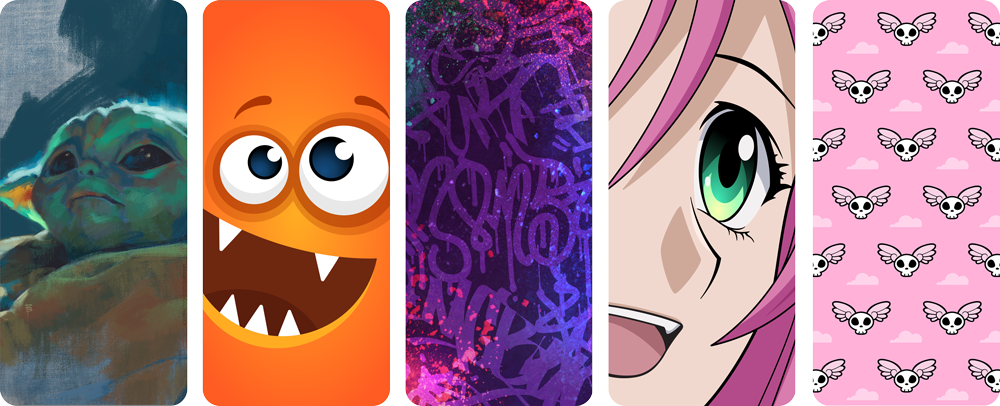
Introducing Wallaroo – the quickest and easiest way to browse and set wallpapers on your iOS devices. The Iconfactory has been crafting custom wallpapers for the Mac and iOS community for over 25 years, and now we’ve packaged them up in a fun, handy app that’s available today on the iOS App Store.

Wallaroo comes with dozens of FREE wallpapers with hundreds more available after you subscribe. New wallpapers are released each week so there’s always something to fit your mood or current style.

It’s also fun to say!

Quick and Easy

Wallaroo’s superpower comes to you thanks to Apple’s Shortcuts. A series of simple actions takes the drudgery out of getting something onto your Lock or Home Screen. Pick a wallpaper in the app, tap a button, and you’re set!

Our wallpapers are organized into collections like Abstract, Comics, Dark Mode, and more. Every wallpaper release also has tags that let you explore and find related content. And when you find a wallpaper you love, it’s easy to make it a favorite for future reference.

Latest and Greatest

For the past three years, our Patreon supporters have enjoyed regular, weekly wallpaper updates so there’s always something new on the horizon. Wallaroo continues this tradition with new and exclusive content each and every week, so the next great wallpaper is never more than just a few days away.

Set It With Style

We’ve always been inspired by popular culture for as long as we can remember. Wallpapers that pay homage to movies, anime, television, or the latest technology are just some of the fun topics to explore in Wallaroo’s galleries. We also love beautiful, abstract, and elegant wallpapers so naturally Wallaroo has plenty of those to offer as well.

Many releases also come with additional colors and layouts for that added touch of customization you’ve come to expect from the Iconfactory. There’s something for everyone in Wallaroo.

No Ads, Only Wallpapers

We’ve thrived over the years by treating our customers with respect. Wallaroo doesn’t collect your information, serve you ads, or push sketchy schemes. We just want to keep bringing you great content and get paid for our efforts. It’s as simple as that.

Give Wallaroo a Go!

Wallaroo is available today as a FREE download on the iOS App Store. Be sure to visit the official product website and follow us on Twitter for more information in the days and weeks ahead. If you love customizing your screens, hop on over and give Wallaroo a go!

Tot & xScope Back to School Sale

August 17, 2022

By Webmaster

Now through August 31st, we’re offering a 30% discount on two of our most popular productivity tools – Tot for note takers and xScope for designers and developers.

Saving a bit of cash is always welcome, even if you’re not a student, so be sure to head to the App Store to pick up Tot Pocket at a reduced price or use the promo code BACKTOSCHOOL when you purchase xScope from our website. Don’t wait, this sale will be over before you know it!

Gaming the System

August 1, 2022

By Webmaster

Those industrious bots are back with an update to our fast-paced puzzler, Frenzic: Overtime. Whizbot’s Test Lab Daily Challenge has received an upgrade to include all new exciting bonuses and strategies as you compete to be the top bot world wide. The Test Lab now also makes it easier to see the players immediately above and below your current rank on the leaderboard, and the bonus meter is personalized by displaying your player avatar from Game Center.

Finally, for those who want to kick back and build power cores at a bit more of a leisurely pace, Frenzic now offers the ability to toggle between Quick Pace and Casual Pace via Settings. Casual Pace means slower chip and shift timers as well as a less aggressive Cipher on Hacker Levels. Just don’t tell BossBot!

Head on over to Apple Arcade and enjoy the latest update to Frenzic: Overtime today!

Tot 1.4 – Making People Happy

June 28, 2022

By Webmaster

Tot, our tiny text companion, makes a lot of folks happy. But with any product, there are always requests for new features. In version 1.4, we’re happy to announce that we tackled our top two requests!

Smart Bullets

A lot of folks, including your humble developers, use Tot for lists. It’s a quick, easy, and unstructured way to keep track of things that need attention. So it makes sense to have a way to check things off in those lists, right?

Prior to today’s release, that wasn’t easy.

And all the solutions we looked at weren’t easy either. Adding in-line checkmarks like Notes was a move away from Tot’s superpower: handling plain text. The size of tap areas on iOS was also an issue: text tends to be a lot smaller than your finger (one of the reasons folks want a magnifier when selecting text).

But after several tries, we finally found a way to do it, and we’re calling the result “Smart Bullets”. These bullets are plain text, but the thing that makes them smart is that you can click or tap to change their state. And when you add a new bullet, it always starts unchecked and stays that way until you change it.

On macOS, you can add a smart bullet using the ✻ button at the bottom of the window. On iOS, you can setup the bullets using Quick Keys in Settings.

Based on our own use over the past month, this is one of those “how did I ever live without this?” features.

iOS Widgets

Dots on your Home Screen? Finally.

The widgets come in two flavors:

  • The Multi-dot layout shows a short summary for each dot.
  • The Single dot layout shows a single dot that you can configure by tapping and holding, then selecting Edit Widget.

Both layouts come in a variety of sizes to match your needs. The heading for the widget comes from your first line of text. The body comes from any subsequent lines.

With the release of support of Shortcuts in the last Tot release, you now have a place on your Home Screen that can be automated with text! One of our beta testers is using the Tot widget for a quote of the day, but you could use it to display system status, the number of days until Christmas, or whatever you can dream up!

(If you want to play around with the Quote of the Day shortcut, you can download it from iCloud. Be aware that it replaces the contents of one of your dots, so proceed with caution!)

And More…

There are bunch of other minor improvements like opening links directly in the app on iOS, improved pointer interactions on iPadOS, and a new Paste and Match Style on macOS. See the product website for a full list of changes.

If you’re new to Tot, you can check out the product website or download a FREE copy today for your Mac. A paid version is also available on iOS.

WorldWideWeb Wows

June 24, 2022

By Craig Hockenberry

WorldWideWeb, our FREE app for running a simple web server has struck a chord with developers and other folks who work with HTML, CSS, and JavaScript. Even the discerning individuals at Hacker News had nice things to say about it!

Today we’re happy to announce an update for both macOS and iOS.

The main improvement in version 1.0.1 is “auto refresh”. As you edit the text files in your Website Folder, the app watches for changes. When an update is detected, a web socket is used to send a notification to the browser that causes a refresh.

A small bit of JavaScript is injected into every HTML page to make this happen, and the feature can be disabled if that causes a problem.

It feels like freedom to work on a site in a text editor and see the browser update as soon as you press ⌘S. Flipping back and forth to refresh is a thing of the past!

The new version also supports drag & drop to get a site going. You can drag a folder onto the Dock icon or Website Folder section of the window.

For other changes, check out What’s New on the App Stores. Your FREE download for macOS and iOS await!

WorldWideWeb, Part II

June 2, 2022

By Craig Hockenberry

The Mac and Web have a long history together. From the very beginning, Mac OS X included the ability to run an Apache web server by clicking a Start button:

A screenshot of Sharing preferences in Mac OS X 10.0
Sharing preferences in Mac OS X 10.0. Courtesy 512pixels.net

About a decade ago, things started to change. Since then it’s gotten harder and harder to start a simple web server for testing HTML, CSS, and JavaScript. I eventually found a way to do it using AppleScript, but as Apple continues to remove open source components from its standard macOS distribution, this workaround isn’t likely to last.

So I decided to write my own web server app. After a bit of research, I landed on the Swifter project for handling the socket connections and file transfers. While not as capable as a production quality server like Vapor, it was perfect for the simple and lightweight solution I had in mind.

The focus for this new app was to not be a production web server. These features are great for development and not something you’d want on a real server:

  • No caching — Every request gets a new response, no cache busters needed
  • Easy to configure — Pick a folder and go, recent folders let you switch sites instantly
  • Directory listings — A handy list of files whenever you hit a URL that doesn’t exist
  • Bonjour support — Automatic DNS for easy access using devices on your local network
  • REST friendly — Set default responses as JSON or XML for easy mocking of APIs
  • No dependencies — Completely standalone, no need for other tools like Python or Ruby
  • Simplified logging — Track requests & responses in Terminal with an easy-to-read format
  • Built-in security — Runs completely in a sandbox, no access to data unless you allow it
  • Powerful and lightweight — A small memory footprint with minimal CPU overhead
  • No rocket science — Perfect for people who are less technically inclined

Once I had all this running on macOS, I stumbled upon something unexpected. All of the Swift code I had written for macOS worked perfectly on iOS. With multi-tasking and a great text editor, iPadOS was suddenly a viable environment for standalone web development.

Bonjour is the glue that ties it all together. It’s effortless to start a server on your Mac and view your content on an iPhone or iPad. Or vice versa. It’s been the perfect tool for managing the video help library content in Linea Sketch: it lets Ged and me work together without a complex setup and ensures that things look great on all screens.

We only had one thing left to do: come up with a good name. During that search, we came across the first name. The thing that made the original WorldWideWeb so great was its ability to combine editing and serving of content into a single app. Our new WorldWideWeb continues that tradition: allowing a single device, like your iPad, to perform both tasks.

Actually, that’s a lie. We had two things left to do: the app also needed a kick-ass icon. It seemed fitting to reach back to the time of Aqua for this one: who better to do that than Dave Brasgalla?

The good news is that both apps are FREE on macOS, iPadOS, and iOS. It felt right to give something back to the web community that has give us so much over the years, so download the apps today and enjoy making great content no matter where you are!

Corey B. Marion 1967 ~ 2022

May 31, 2022

By Webmaster

Last week we paused to remember the life, art and legacy of Corey Marion, our beloved friend and Iconfactory founder who passed away on Sunday, May 22nd. Corey was a kind, talented and amazing person who touched the lives of all who knew him by his digital creations and generous deeds.

We love you now and forever, Corey. 🖖

Announcing Linea Sketch 4.1

May 17, 2022

By Ged Maheux

Today’s update brings a host of new features specifically designed to make Linea Sketch easier, quicker, and more flexible than ever before. With this new version, you can turn any drawing tool into a textured eraser, sketch inside strokes and canvas elements, organize projects into handy collections, and watch video tips and tricks in a new Video Help Library. 

Less Really Is More

Linea Sketch 4.1 lets you turn any of the app’s drawing tools into a textured eraser. Select the Clear Ink swatch from the top of the color palette, then draw or paint with your tool of choice to “erase” areas of your sketch.

Clear Ink is great for blending areas of one layer into another, knocking back part of a layer into the background, and much more. 

Always Draw Within the Lines

Linea’s new Transparency Masking is a great way to re-color existing parts of your drawing or sketch. Once activated from the Layers palette, transparent pixels are ignored, confining your drawing to only what’s visible on the current layer.

Add textured shading inside shapes with Linea’s pencils, flood fill entire shapes with new colors quickly and easily, or paint with Linea’s watercolor brush, all without having to worry about adding pigment where you don’t want it. 

You can even use the blending tool in combination with Transparency Masking to create soft gradients and tonal transitions within existing strokes, doing away with the need to erase afterwards.

Stay Organized and Save Time

Linea now offers users a way to place projects and their associated sketches into handy collections that can be arranged and organized to fit your work. Collections let you group similar projects together for easy, quick access.

Use them to archive older work and get it out of view, keep work separate from play, or cross-reference sketches by assigning a single project to multiple collections.

You can also assign a custom thumbnail to a collection for quick reference. Collections sync to all devices via iCloud and are a great way to stay focused on what’s most important.

But That’s Not All

A new Video Help Library lets you watch tutorials, get in-depth walk throughs of Linea’s features, and enjoy time-lapse drawings. Topics include a wide range of frequently asked questions and include “how to” sessions to get the most out of the app. You’ll even get an in-app notification when new content is added.

You can even watch videos using iOS’s picture-in-picture feature to follow along while working in Linea!

We’ve also added the ability for Linea Link, our free companion app for macOS, to safeguard your work and automatically backup your sketches on launch. If you own a Mac, Link’s new auto-backup feature is invaluable. 

There are many more improvements, including a new Trash container in the Project view to safeguard your sketches, new Apple Pencil double-tap actions for use with Clear Ink, improved color handling, and even a fun, new selection of templates for playing games.

Today’s update is the perfect opportunity to see why so many people call Linea their favorite sketchpad. Visit Linea’s version history page for the complete list of what’s new, and then head on over to the App Store and grab the FREE download of Linea Sketch. It’s where your ideas begin!

You Can’t Keep a Good Bot Down

May 10, 2022

By Webmaster

Frenzic: Overtime, Chapter 2

When last we saw DoBot and his factory friends, they had just finished saving the world. Unfortunately for them (but fortunately for you) their work isn’t over yet. We’re proud to present Chapter Two of Frenzic: Overtime!

Chapter Two continues the adventures of DoBot, InfoBot, and WhizBot, as they’re pursued by a hit squad of HenchBots. This chapter adds over 30 new levels, new goals and achievements, along with some exciting new game mechanics.

Head on over to Apple Arcade to get Frenzic: Overtime and keep building those powercores!